candystore

candystore
Showing posts with label information literacy. Show all posts

June 20, 2017

Systems for organizing information

During grade 2 unit of inquiry "Systems" the class explored the system ISE Library uses for organizing books. Students learned grouping books by type (fiction and nonfiction), numbers and letters. Through inquiring into and discussing information they saw on the books (call numbers) and on the shelf labels they discovered the ten groups of the Dewey Decimal System, and that books on the similar subject are together on the shelf. Touring around the library students noticed that not all books have numbers which led us talking about the alphabetical order and types of book that are organized this way.
What Dewey section are your favourite books in?
We then looked into the library online catalog and noticed the call numbers there as well. Combining the learning students worked as detectives following clues (call numbers) to solve a problem (finding a book of interest from the shelf). Next time we revolved the activity and students worked as library assistants putting books back to their correct places on shelves. This activity turned out to be more a challenging one. All students though, some with a little help from a friend, managed to find books of interest. One student in particular displayed the calling for a librarian profession by quickly understanding how the library system works, and efficiently carrying out the duties of retrieving and returning books to the shelves. He insisted keeping re-shelving books during free reading time. What joy!

Our next exploration into systems of organizing information, building on learning from this unit, is looking into how can we use alphabet to find things? We will be exploring enrollment lists, dictionaries offline and online and look into online directories. The objective of this unit is to learn how to search online by using the alphabet and how children's directory sites are organized.

Exploring lists and dictionaries
As a summative activity we explored the www.a-zanimals.com Endangered animals site that organizes its information alphabetically. Grade 2 created their own A-Z book of endangered animals using information from that site. This activity was completed in collaboration with the "Endangered animals" unit of inquiry. Students were able to transfer their knowledge and terminology learned (extinct, endangered, threatened) across subjects. Look at some examples from the book. Do you know who is an axolot, or where can you meet quoll. How is uguisu's poop used, and how x-rat tetra looks like?


May 15, 2017

Whose is it Anyway?

During the month of April we explored with grade 4 how can we use other people's work respectfully with an objective of understanding plagiarism and citations. For provocation I used puppets students had made during their Drama unit, claiming I made some of them. Afterwards we discussed how this made the students feel (shocked, surprised, confused), and what I was really doing (stealing and lying). I got reminded of my "bad" behaviour multiple times during this unit.

The new knowledge was applied to writing citations for the individual investigations about an ancient civilization during grade 4 unit of inquiry. We started with looking at how to cite a book, and rather sooner than later students came back with questions like: "How do I cite an article from a webpage?" "What about the videos from YouTube?", and "I used an article from World Book Online. How do I cite it?" I worked with small groups in grade 4 classroom based on their needs, explaining the above situations and introducing Easybib programme. We started with simple citations, and a few steps when using Easybib for the students to understand why and how to cite.

We then looked at citations and elements included in a citation, discussing reasons for adding these parts. For example, the author name which comes first to acknowledge and give credit to the person who created this piece of work.e, what tools to use, and what do the elements in the citation mean."

... because then you don't show respect.

At the end of the unit I asked students to share their biggest takeaway/learning. Here's what one student said: "I learned that when you use someone's work you need to give credit and respect to the people because if you don't it's plagiarism." And another wrote: "Always cite or else you are stealing."

I learned that you have to give credit if you use someone's work.

Lesson well learnt:)

April 11, 2017

Exploring the rings of responsibility

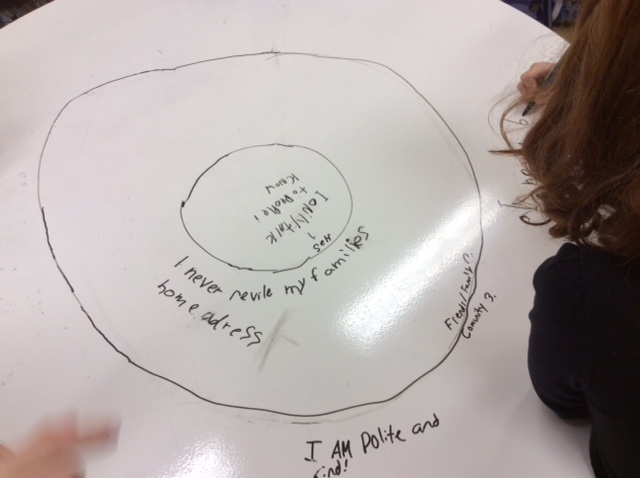
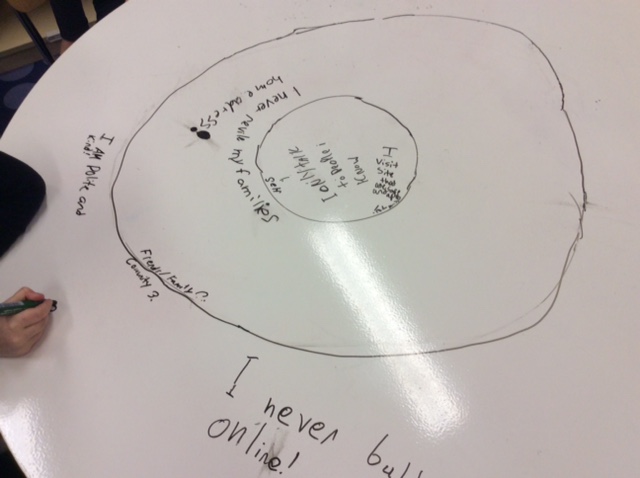
Instead of an online approach through eTextbook (see December 18, 2014 post "Grade 3 eUnit "Rings of Responsibility"), this year, I decided to engage with the offline learning to explore this important topic, and use smart surface library tabletops instead of iPads to record students' thinking and ideas.


Students

  • reflected upon their offline responsibilities
  • examined their online responsibilities
  • learned that good digital citizens are responsible and respectful in the digital world (and beyond).


We discussed offline and online activities to self, friends and family and larger community and realized that it is important to be kind and respectful in both face-to-face and online world. This approach worked very well and students were excited to us an alternative media to record their thinking.

.

March 2, 2016

What makes an IB library?

I couldn't agree more with the author, Stuart Crouch's, view on inquiry based learning and collaboration in between IB Librarians and teachers. I am glad to notice that I am on the way as I teach in collaboration at PYP and MYP level. As Stuart writes "The increased role of approaches to learning skills, such as information literacy and media literacy in our curricula, have meant that librarians are in demand like never before." 

I have had great collaborative classes with our MYP Science, Humanities, English and Music teachers. Connecting learning skills to the actual classroom experiences makes the benefits of acquiring and applying these clear for the students. And librarians can help out with developing other skills as well. Talk about organization in the library context. It's all about it. Our year 5, grade 10, students are about to complete their Personal projects, an engagement I as the Coordinator have guided, pushed and pulled them through.

Bits and pieces have happened with DP students as well. Mostly introducing the quality scholarly resources in and outside our library for their Extended Essay and TOK papers. Also, library being a place to crash at for studying and/or relaxing:) 


Some latest collaborative activities include PYP grade 3 innovation unit and exploring e-books, PYP literature circles, MYP information literacy classes on search techniques, plagiarism and citations workshops, and DP visit to the Tallinn University Academic library.

ISE IB Collaborative activities
Thanks for the great insight! I still have a leg of a journey ahead but I know where I want to get to. 

Read the full article How do you build your library to support inquiry-led learning? by Stuart Crouch.

February 5, 2016

ISE Library working in collaboration with Tallinn University Academic Library

International School of Estonia and its library are happy to start a collaboration with Tallinn University Academic Library in sharing their abundance of printed and electronic collection, providing our DP students with a scholarly resources for their Extended essays, TOK papers and other coursework. 


Tallinn University Academic Library (Estonian: Tallinna Ülikooli Akadeemiline Raamatukogu) is one of the most comprehensive research libraries of Estonia in all fields of knowledge. 
The library was founded in April 1946 as the Central Library of the Estonian Academy of Sciences. Although the library is quite young, the Library of St. Olaf's Church (founded in 1552) makes up the oldest part of the collections.

Image source: Tallinna Ülikool, Akadeemiline raamatukogu http://www.tlu.ee/et/akadeemiline-raamatukogu

The library holds over 2.5 million items. The number of the readers amounts to nearly 50,000. During the years the library has gone through several administrative changes. It is acting as a part of Tallinn University administrative structure as of 2003. 


In February Grade 11 students, Ms. Beth Dagitses, DP Coordinator and Ms. Kadri Tomson, MYP Coordinator and librarian visited the Academic library to set up the collaboration and register as readers at the library.

One of the many reading rooms
The stacks
Home lending room


Signing up to become the readers.

December 9, 2015

PYP Information literacy projects - grade 3

In collaboration with grade 3 unit of inquiry on innovation and how innovations change the way people do things and approach problems students have been looking at and talking about how innovation has impacted the way people get books and read during Information studies class. We learnt that books come in various formats and may be read in different ways. Different people prefer different formats.
Grade 3 students in Information studies
Students brainstormed, recorded and compared similarities and differences of printed and e-books using Venn diagram.

Brainstorming with the help of the smart surface tables in the library.


Differences

Similarities
We keep practicing accessing two e-readers available at ISE: MackinVia and Follett Shelf. Please contact library@ise.edu.ee for log-in information. Later on students will reflect on their experiences with electronic books with printed texts with a focus on ease of access, reading experience.

Stay tuned! What do you think - is technology helpful in promoting reading?

PYP Information literacy projects - Grade 5

ISE believes in supplying accuracy, objectivity, and reliability in research materials for both children and adults. Our carefully selected subscription databases, EBSCOhost and The World Book Online are among the industry leaders of award-winning encyclopedias, reference sources, and digital products for the home and schools. 

In preparation for their final Exhibition grade 5 students have been exploring World Book Online database with and inquiry into a central idea "A database gives access to a large amount of verified information stored in a computer system." Students learnt what a database is and what sort of information does it have, how to access the database and when and why (the benefits) to use one. 
Students conducted a mini research on a topic of interest using information from the World Book Online database following the research cycle of accessing, finding, evaluating, paraphrasing, presenting and citing their information. Students used the Thinglink interactive images app for presentations.


Follow these links to student Projects:

Basketball by Daniels 

Deforestation by Mihkel

Reading by Dominika

Chemistry by Anna

Snowboarding by Vilja

We continue fine tuning students' citations and bibliography following MLA format and learning to use Easybib citation tools. 
Stay tuned!

September 2, 2015

Welcome to the new school year MYP!

The school year has started and we are at the full swing at ISE and in the Library by now.

Below is some info about what library has to offer for upper school students and how information literacy and research skills are addressed at MYP, middle school level. 

     Academic honesty
MYP programme takes academic honesty very seriously. One of the four policies all MYP schools have is an Academic honesty policy. ISE adopted one at the end of last school year and is implementing it into teaching and learning this school year.
All MYP students signed an age appropriate student version of the policy agreeing to demonstrate academic honesty and avoid any form of academic misconduct.

Academic honesty in the IB is described by the IB learner profile. As stated in the IB learner profile, all members of the IB community must strive to be “principled”, acting with “integrity and honesty, with a strong sense of fairness and justice, and with respect for the dignity and rights of people everywhere”.
ISE’s Academic Honesty Policy focuses on prevention and promoting good practice. It is our goal for the entire school community to view the principles of the Academic Honesty Policy positively.

In IB the programmes, students develop skills that are important across the curriculum and help them “learn how to learn”. Students will learn and practice academic honesty as part of the ATL skills in various classes, receive and sign an age-appropriate, copy of the policy and understand that the coordinator and teachers are available for further advice and guidance.


We encourage parents to teach and support the ethical values of honesty and integrity and share ISE’'s enforcement of the academic honesty policy, especially with regard to work done outside of school. ISE helps and encourages students with schoolwork, but never does it for them.

                  Binghamton University students talk about academic honesty.

     Information literacy
This year information studies are integrated into subject group units of study. MYP subject teachers and I will  be looking into ways how to collaborate when teaching and learning ATL (approaches to learning) - research and information literacy skills in an authentic settings while exploring UOS topics. 

     Personal project
For the second year I am the Personal project Coordinator at ISE. The MYP culminates in the personal project. Year 5 (grade 10) students engage in the Personal Project. It is a mandatory project in the Middle Years Programme. The project is an opportunity to explore a topic of interest, to develop ATL (approaches to learning) skills and to create something unique, to demonstrate a consolidation of learning in the MYP (what they have learned during the 5 years in MYP). ISE library offers support with finding resources in and outside school for the research portion of the project.

Besides wearing the hats of a librarian, an information literacy specialist and a Personal Project Coordinator my new role this year is a MYP Coordinator.
Last but not least the library is a homeroom for grade 8 this year.


We like it here!


September 1, 2015

Welcome to the new school year PYP!

The school year has started and we are at the full swing at ISE and in the Library by now.

Below is some info about how library time is allocated at PYP, primary school, level. This year I will also be looking for further collaboration with core classroom teachers to teach and learn about information literacy skills in an authentic setting while exploring UOI topics.

Lower school students come to the library for weekly library and information studies class. During that time we learn about library behaviour, book care, and an orientation to library matters and subjects according to their grade level. Research skills are essential for studying and learning; therefore these skills are reinforced in information studies lessons at the upper elementary level.

We read stories with younger students every lesson, discuss and explain what is happening in the story. Students have an opportunity to show their communication – viewing, listening and speaking; thinking and social skills, and share their experiences. Stories are often connected to the UOI topics learnt in homeroom.

Upper elementary students focus on learning research skills; how to locate, organize and use information. We search ISE Online catalogue, and learn to use reference tools available at ISE library. We talk about plagiarism and what is “good” information.

At the end of the class students have a chance to find a book for home reading. Students start taking books home beginning Reception class. The choice is up to your child, as to what she or he wants to read. Each child has a blue library bag. All new students will get a bag from the librarian, and it has to be returned at the end of the school year. Children can keep their books up to 4 weeks, but new books can’t be checked out until the previous one is returned. Therefore, younger students might need a reminder to take their books back to school at the right time.

I am looking for happy exploring and exciting discoveries at the library and occasionally some cookies:)

February 18, 2015

My Search Story: Grade 8 project

We have been learning about Google Search with grade 8 students using the below links for information and ideas. 
Google: Year in Search 2014 http://www.google.com/trends/2014/
Inspired by the first link students created their search stories. They created their stories with 30hands app that combines images, photos, drawings, text (typing and/or writing) and audio into a short movie. Take a look at the three examples to learn what Google features grade 8 students use the most.

Erica´s Search Story

Anjali´s Search Story


Freddie´s Search Story

We continue with discussing pros and cons of Google Search. Students search the Internet, Google:), to find articles on that topic. They will possibly find information about other search engines as well. Then they are required to use different search engines to see if your results are the same. We will analyse and reflect on the finding of this activity in writing sharing the ideas and conclusions with the whole class.
Check back to see what did grade 8 students learn.

December 11, 2013

MSP Info studies project Digital Life

At the end of this semester during MSP Info studies Digital Life unit we learned about appropriate online behaviour, and discussed what to do and how to report if you have a problem. Using the unit materials students created "Tips for Teens" presentation for safe and smart online behavior using Prezi app.
Please see below 5 top presentations. Are you following their advice?

Prezi by Teele

Prezi by Hannah

Prezi by Elliina

Prezi by Minh

Prezi by Mary

October 4, 2013

MSP Info studies - Research cycle

We started the Information studies course with learning about the Research cycle. In order to complete research papers successfully it is important to understand what are the stages we go through while doing research, and what happens at each stage. Understanding and following effective research strategies results in deeper knowledge and successful work outcomes. The course is built around the research process discussing topic that arise from doing research. As the final assessment students created and designed their own research models. They had to include at least 4 stages; give each stage a name and write a brief description/explanation for it. They were allowed to use any graphing tool.

I am glad to share the top 3 models.

Research model by Elliina Gorobets

Research model by Patrick Williams

Research model by Mary Neuburger


April 16, 2013

What's happening at the MSP Info studies

Last week we wrote Info studies reflections with middle school students. See below what they say about their studies.

I did a really good job on the Google a Day activity. The Google a Day is a thing were it gives you questions and you have to find the answer to the question using different search techniques. Josh Gr 6

Some benefits [of Info studies course] are that I can improve and learn new skills. Kento Gr 7

I have learned how to search, to get better information quicker without having to read a lot. Calle Gr 7


Some benefits are that I know how to cite a source and how to search on the web for information I need. Alexandra Gr 8

The benefits are that I learned more about Wikipedia and I know now that I shouldn't use it as a primary source as everyone can edit it. I am struggling with getting too much information at once then I won't remember everything, and when we need to write I struggle with deciding what to write. Marius Gr 8

I think the benefits that I will actually use [from this course] are citing and also knowing about Wikipedia. It will be good for my studies and help me get better information for research. Teele gr 8


The class had taught me how to cite and use Wikipedia better without getting wrong answers by people who change the information. I'm still struggling with finding out which information is right and wrong. Minh Gr 8


The benefit for me in this class is that it helps me with researching techniques. Jamie Gr 9

This course has been a big help to me especially when researching the different search engines and how to properly cite the sources used.  I have also learned a lot about how to even more narrow down the information needed on search engines such as Google.  Caroline Gr 9

I learned a lot of things, which I never knew before. Valentin Gr 9


April 15, 2013

What's happening at the library

Read about what we have learned in Lower School and what students wrote for their portfolio reflections.

Preschool Juniors
Preschool Juniors had a collaborative Library and UOI unit “Once Upon a Time” in preparation for the Book Week “Telling Stories through different Media”.
Fairy tales are, in a sense, the first examples of classic literature that students encounter. Every country has stories that are so old; people cannot remember where they came from. Long time ago when people did not have books, radios, TVs, or computers stories were told for fun and entertainment, but also to teach a lesson or warn children of danger. Stories were told to one another over and over again. Nowadays popular fairy tales are written down in books and turned in films for children and grown-ups to enjoy.
In the library we shared popular fairy-tales through different media. We explored the tales of “The Little Red Riding Hood”, “The Three Little Pigs” and “Goldilocks and the Three Bears” through flannel-board media, listened to audio- and watched video stories. We also read traditional printed books.
We talked about what these stories teach us, how they make us feel.
Students showed enthusiasm and curiosity during class time. They showed confidence joining in at the repetitive parts. Students eagerly waited for their next Library class to see what the next tale was about.

Preschool Seniors
Preschool Seniors have learned about book care - why is it important to take good care of books and what are some ways to care for books?
In preparation for the book week we focused on listening to audio stories of “Jack and the Beanstalk” and preschool’s favourite “Tacky and the Three Bears” among other activities.
Students displayed cooperation while quietly listening to the audio stories. They showed creativity and commitment while completing their activity sheets, and sharing their ideas with the classmates.

Reception
In Library class Reception students have learned about library behavior, fiction and non-fiction books and read lots and lots of stories.

“I like looking at the books the best even though I don’t know how to read.” Gabe 

“I like to draw. I like books, too. I mostly like scary books and pretty books. There is a scary book about Ghosts in the library.” Hadley 
Grade 1
In conjunction with Gr 1 UOI “Just Imagine” and preparations to the Book Week we talked about what authors do, why writers write, and looked at different media to share stories e.g. audio books, video stories, e-books on iPads. Of course during the year, in almost every class we have read traditional, printed books as well.

“I enjoyed watching the video story “Where the Wild Things Are”. I liked the way the video story was made using pictures from the book not making a cartoon. “ Amelie 

“I learned that writers write because they like to do it. They think it’s nice to share their ideas. And we can learn.” Dora 

“I learned that we put books on the shelf in an alphabetical order. If the author’s second name starts with B the book goes in B section.” Marco

“I have enjoyed reading e-books on my iPad. I like these because you can do extra activities, touch something to make things happen for instance the car changes color. I liked “Dino-Store” e-book the part when the dinosaurs worked in the store. I have learned to use e-books in the library.” Philip


Grade 2
Grade 2 students learned about different parts of a book, and how each part can be helpful. Working as authors and illustrators we made Grade 2 Best Books book including parts learned about and shared it during Book Week. Grade 2 favourites are Captain Underparts by Dav Pilkey, The BFG by Roald Dahl, The Dragon in the Library by Kate Klimo, Dork Diaries: Tales of Not So Talented Pop Star by Rachel Russell, Bailey by Harry Bliss and Moosetache by Margie Palatini.

Grade 34
In Library we learned that book recommendations are a way to express and share your ideas and thoughts about a book. You can use a book report, review, talk or trailer format to share your reading and learn about books. Grade 34 students wrote a book report to inform about their reading. Their reports along with books are on a display in the library.

“When I was writing “Charlie and the Chocolate Factory” report I liked that I used exciting words. Next time I will write a bit more. I think that Charlie and the chocolate factory is an outstanding book!”  Mike Gr3

“To recommend a book you can make a book trailer, a book report, a book review and a book talk. A book report includes the author, the title and your personal thoughts.  I think you don’t always have to include the thoughts that are bad because if you do, people might not want to read the book but the job you are trying to do, is to get more people to read it. I also think you should always be honest when you write a book review because sometimes you have to write it about a book you do not like, and you can’t make it sound more interesting or worse than it actually is. I am a curious student who likes asking questions and reading books.” Amelie Gr4

“A report is when you write about a book you like and want to recommend it. I always read what I have to read. I show the attitude of appreciation because I am happy to learn.” Glenn Gr4

“A book recommendations are helpful if you friend doesn't know what to read so you recommend your friend a book. The elements that are always included in a book report are the title, author and the summary of the book plus your thoughts.” Rasmus Gr4


Grade 5
Grade 5 completed a unit on plagiarism and citing. We learned what plagiarism is and how to avoid it. We know now that when you do a research project you must give credit to the sources from which you found the material you used in your project.


March 11, 2013

Information studies in middle school

Reseach cycle by Jamie Godfrey Gr.9
  • During the 1st quarter we learned about the research cycle the process of gathering, analyzing and communicating information. Students studied and compared different research models. They looked for patterns, connections and similarities in these models. Using the information from their studies they created their own research models, making a visual/graphic representation for it as well.
  • We also learned what does plagiarism mean? That plagiarism is an act of fraud. It involves both stealing someone else's work and lying about it afterward. Plagiarism is a big deal, and it’s not something you want to find out about the hard way. 
  • 2nd quarter discussions focused on what does "citing a source" mean? Whenever you use material that you got from another source in your research project, you must let your audience know where it came from.You have to cite your source because it is not appropriate to use other person’s ideas, thoughts and words as your own
  • We continued with Web Search Strategies unit comparing benefits and challenges when searching the Online databases and the web, looked at some general web search strategies and explored Google search engine further from standard search function. That took us to the 3rd quarter.
  • Can you complete these "A Google A Day" challenges?
  • Currently we are exploring Wikipedia look at what wikis are, learning what Wikipedia itself says about using it as a source, acknowledging special research considerations concerning Wikipedia.


September 25, 2012

What's happening at the library

Read about what we are learning in Lower school

Preschool Juniors 
We are reading lift-the-flap stories, looking for little surprises hidden in the books related to the story. We are reading about animals and school, and making our very own"Dear Zoo" lift-the-flap book.

Preschool Seniors
In collaboration with PS Unit of Inquiry "SENSE-ational "People get information through their five senses", we are learning how using our senses help us choose books and understand how the library works. We listen to library sounds and stories, look at the pictures and touch textured books, we sense how old and new books smell, and that books are not eatable, do not taste good.
Reception
We are learning about book care. We know that books are our friends and we care for them. Each student is working on their very own book care booklet "I Know How to Take Care of a Book" focusing on keeping library books safe and in good shape for everyone in school to read and share.
After this unit Reception students are ready to start checking books out from the library for home reading.

Grade 1
Students learn about the library and how to use its resources appropriately. We learn what a librarian does and look at various resources library offers to the students. We talk and write about student favourite library activities. Grade 1 loves the library!


Grade 2
We have been reading humorous stories with Grade 2 and talked about what makes a story funny: funny pictures and details, unexpected and a bit naughty situations, preparing your mind to a funny story/situation. We have been telling jokes and drawing funny extensions to the stories read in the library. We agree with the quote: "I am thankful for laughter, except when milk comes out of my nose." Woody Allen


Grade 34
In collaboration with grade 34 language arts classes we have been talking about how to choose "just right" books, exploring the different purposes readers have and how to determine what their purpose for reading is. Also, we have been learning how to evaluate whether a book is at the right reading level and length for their abilities. We will keep practicing and choosing books during our library time.

Grade 5
During our unit "What's at the library?" Grade 5 students learned that libraries offer easy-to-use and reliable resources when researching a topic for a school report. We discussed the advantages of doing research at the library and evaluated the importance of various library resources. Now, Grade 5 students are making a poster to promote ISE library.

New Information studies class in Upper school

For the very first time we are offering Information studies class in middle school. Information studies course consists of research skills course focusing on developing skills, understanding and knowledge needed for accessing, interpreting, using and sharing information from variety of sources and for variety of purposes, and individual research time.   

Information exists in a large variety of kinds (facts, opinions, stories, interpretations, and statistics) and is created for many purposes (to inform, to persuade, to sell, to present a viewpoint, and to create or change an attitude or belief). Students need to learn critical reasoning, evaluation of information to figure out the information world.

In class we have been learning about research tools at ISE library; looking at Online catalog, subscription databases available in school and useful websites accessible on Estoodle Library course.
Now we are learning about the research cycle - the process of gathering, analyzing and communicating information.
Understanding and following effective research strategies results in deeper knowledge and successful work outcomes.